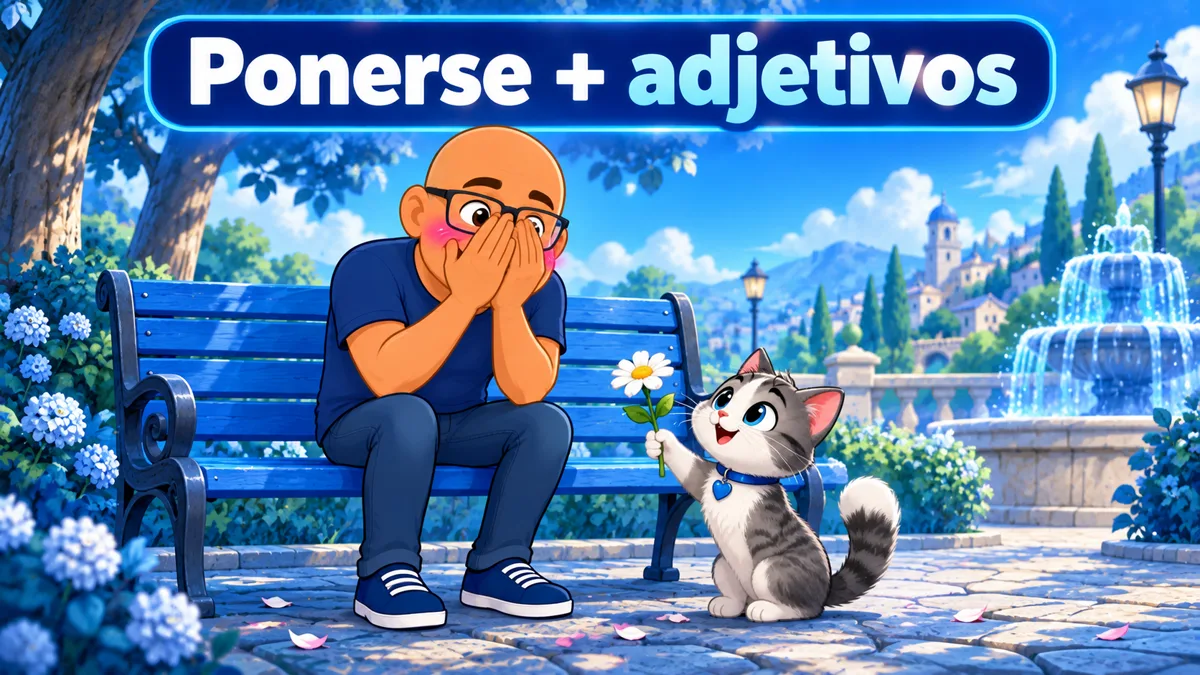
In Spanish, the verb poner means to put. Its reflexive form, ponerse, literally means to put oneself. However, when used with adjectives, ponerse is commonly used to express temporary changes in mood, physical condition, or emotional state. In these contexts, it is often translated as to get. Here are some examples:
 Click and listen!
| Spanish | English |
|---|---|
| Me pongo nervioso. | I get nervous. |
| Ella se pone feliz. | She GETS happy. |
| Nos ponemos tristes. | We get sad. |
Common expressions with “ponerse + adjective”:
PONERSE + ADJECTIVE usually refers to temporary feelings or conditions rather than permanent traits. However, there are some expressions describing temporary states where using ponerse doesn’t sound natural in modern Spanish. Don’t worry about those exceptions for now — we’ll cover them in future lessons.
Below is a list of common temporary states where this construction is typically used. Notice that in English, all the expressions I selected include the verb to get:
Click and listen!| # | ESPAÑOL | ENGLISH |
|---|---|---|
| 1 | PONERSE CELOSO | TO GET JEALOUS |
| 2 | PONERSE CÓMODO | TO GET COMFORTABLE |
| 3 | PONERSE CONTENTO | TO GET GLAD |
| 4 | PONERSE FELIZ | TO GET HAPPY |
| 5 | PONERSE FURIOSO | TO GET FURIOUS/ |
| 6 | PONERSE INQUIETO | TO GET RESTLESS |
| 7 | PONERSE NERVIOSO | TO GET NERVOUS |
| 8 | PONERSE PESADO | TO GET ANNOYING |
| 9 | PONERSE SERIO | TO GET SERIOUS |
| 10 | PONERSE TRISTE | TO GET SAD |
When describing changes related to colors, English speakers often avoid using to get. For example, ponerse colorado is translated as “to blush” or “to turn red,” rather than “to get red.” Here are a few examples:
Click and listen!| # | ESPAÑOL | English |
|---|---|---|
| 1 | ponerse azul (por falta de aire) | to turn blue (from lack of air) |
| 2 | ponerse blanco | to turn white / |
| 3 | ponerse colorado | to blush / |
| 4 | ponerse pálido | to go pale / |
| 5 | ponerse rojo de ira | to turn red with anger |
| 6 | ponerse amarillo (por enfermedad) | to turn yellow (jaundice) |
Let’s play the following game so you learn these expressions in a snap!