A Short Review, What’s a Verb?
A verb is a word that expresses an action, event, or state. It tells us what someone or something does, what happens, or what someone or something is like.
Some English verbs are do, walk, and eat. Verbs are essential because they show what happens in a sentence and when it happens.
Spanish Verbs
Spanish verbs can be challenging for English speakers because they work differently from English verbs. In English, we often use helping verbs such as will and would to express different tenses. In Spanish, the verb itself usually changes to show who performs the action and when it happens. For example, hablar means “to speak.” In the present tense, it changes according to the subject:
The verb ending identifies both the subject and the tense. Spanish often allows us to omit the subject pronoun because the verb ending already shows who performs the action. For example, hablo already means “I speak,” so we do not always need to say yo.
Verb Endings
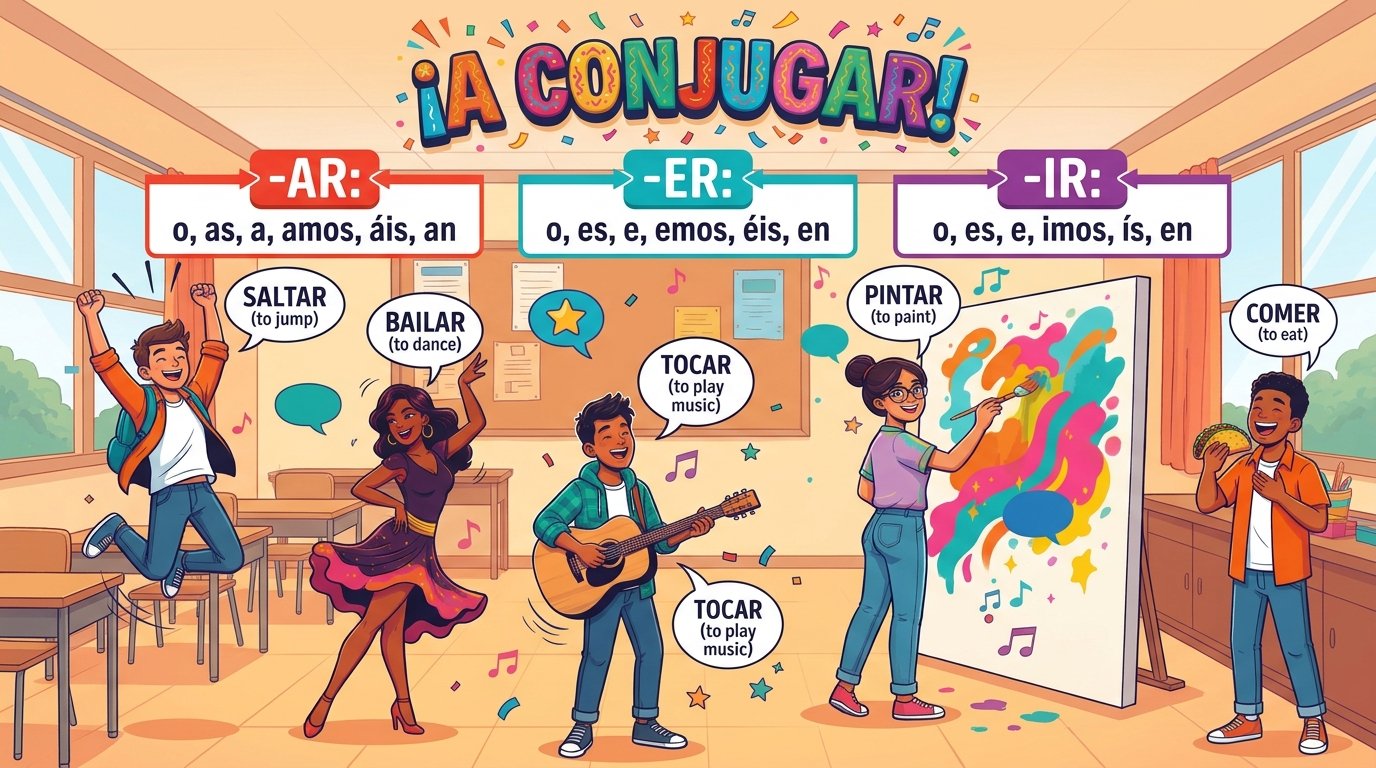
Spanish verbs usually end in -ar, -er, or -ir in their infinitive form. The infinitive is the basic form of a verb, like “to speak” or “to eat” in English. For example:
These three groups generally follow different conjugation patterns. Many verbs are regular and follow predictable patterns, while others are irregular and change in less predictable ways.
Verb Tenses and Moods
Spanish verbs can express when an action happens, such as in the past, present, or future. They can also express different situations, including commands, possibilities, wishes, and hypothetical events. And more! For example:
Learning Spanish Verbs
Spanish verbs can be one of the most challenging aspects of learning the language. Each tense follows its own conjugation patterns, and Spanish has more tenses than English. For example, Spanish uses two different past tenses to express ideas such as “I was eating,” depending on the intended meaning.
Below is a collection of posts about Spanish verbs. It begins with the essential tenses and gradually progresses to more advanced ones. Many posts also include links to related topics.
You do not need to learn everything at once. I’ll guide you through each step and help you track your progress along the way.
Teacher Martincho’s Spanish Verb Guide
Choose a tense to begin your lesson!